Over the last 5 years, Make Space for Girls has listened to over 500 girls and gender-diverse young people talk about parks. You can hear some of their voices in the video for Make Space for Girls Our Parks Too campaign.
Listening to these young people matters: it matters because teenage play matters; it matters because parks are important to teenage play, and it matters because the research is clear: the spaces provided for teenage play in parks (skateparks and multi-use games areas) are dominated by boys and young men. You can read more about the research into why all this matters in our Make Space for Girls Research Report 2026. Teenage girls have told us that there are lots of reasons why they don’t feel welcome in parks. The facilities provided; the design of spaces; judgement (of their looks and actions); the implicit rules about who’s entitled to use spaces; and safety.
Safety matters: in a 2022 research report, “Make Space for Us”, just under a third of girls said not feeling safe stopped them from using parks. And being active increased this sense of vulnerability with 49% of girls age 13-15 saying they didn’t feel safe to exercise in the park, compared to 26% of their male peers.
The question is often asked: “Is this park safe?” But if people are interested in making teenage girls feel welcome in parks, the better question is: “Does this park feel safe to them”. When it comes to public space, there is no objective test of safe/unsafe: what feels safe to one group may not feel safe to another. For example, research into parks in Leeds showed that 89% of park professionals felt their parks were safe for women and girls: but only 22% of teenage girls felt the same. Both perceptions of safety were equally valid; but the latter would have a much greater impact on whether teenage girls use the park than the former. If people are interested in making teenage girls feel welcome in parks, this requires a broader view of safety, beyond crime statistics and how park professionals feel about their parks, to encompass the views of teenage girls and gender diverse young people.
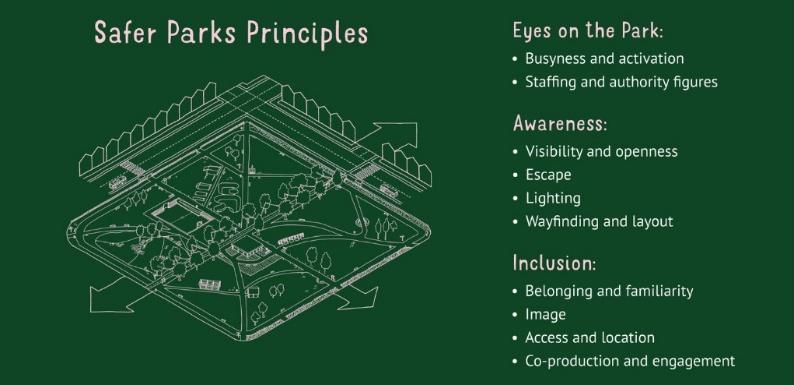
We were therefore excited in 2022 to be invited to be part of the development of guidance based on research by Dr Anna Barker and her team at Leeds University which had sought out these views. This guidance Safer Parks: Improving access for women and girls, is embedded in the Green Flag Awards Programme; and by 2025 over 500 parks managers and 200 Designing Out Crime Officers had been trained using it.
And on 5 October 2026, Leeds University and Police Crime Prevention Initiatives launched a new free online course for park professionals, landscape architects and designing out crime officers based on this guidance: https://onlinecourses.leeds.ac.uk/safer-parks
Using practical examples and case studies, the course brings the guidance to life and provides space for learners to develop realistic actions to implement in their work. If you have previously attended a Make Space for Girls CPD, you might see the odd familiar face; and it is 45 minutes well spent!